ohmSTAR and ohmSTAR+
A decade box on an ego trip.
The perfect device for simulating RTDs, testing PLC inputs, calibrating thermostats, faking thermistors, strain gauge simulation, ATE test stations, HVAC controller testing and classroom labs.
From $987. One set of test leads in the box.
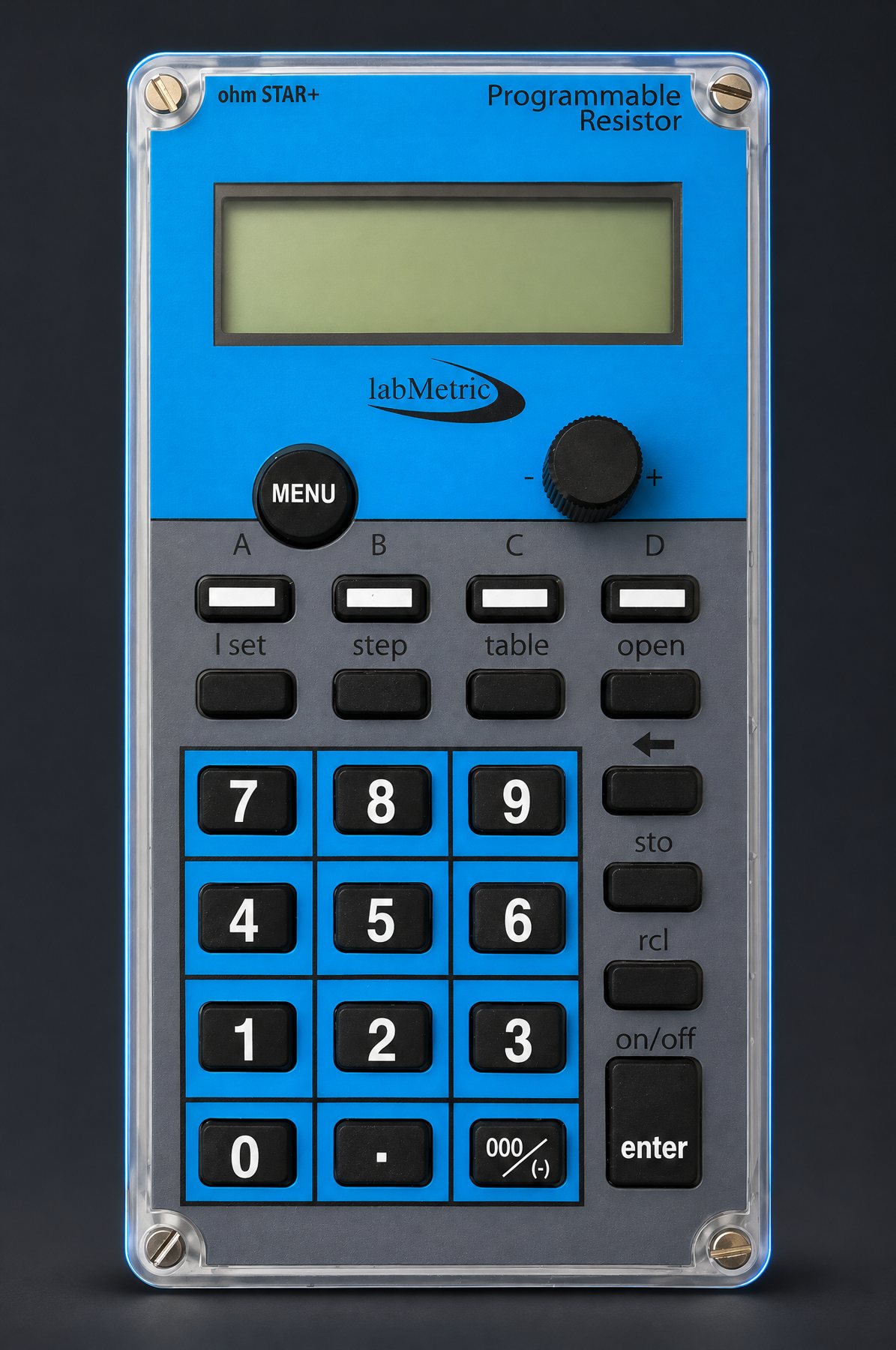
- Range
- 1 Ω to 25 MΩohmSTAR
- 1 Ω to 5 MΩohmSTAR+
- Resolution
- 0.1 ΩohmSTAR
- 0.01 ΩohmSTAR+
- Switching
- Mechanical relays, full relay isolation
- Accuracy, 1 kΩ to 1 MΩ
- ±0.1 %ohmSTAR
- ±0.05 %ohmSTAR+
Used by engineers at leading aerospace, defense and consumer tech brands.
Any sensor. Zero effort.
Use it to check controllers and transmitters with known sensor values, simulate sensors, run production test racks, stand in for missing resistor values, test HVAC and PLC inputs, and teach sensors in the classroom.
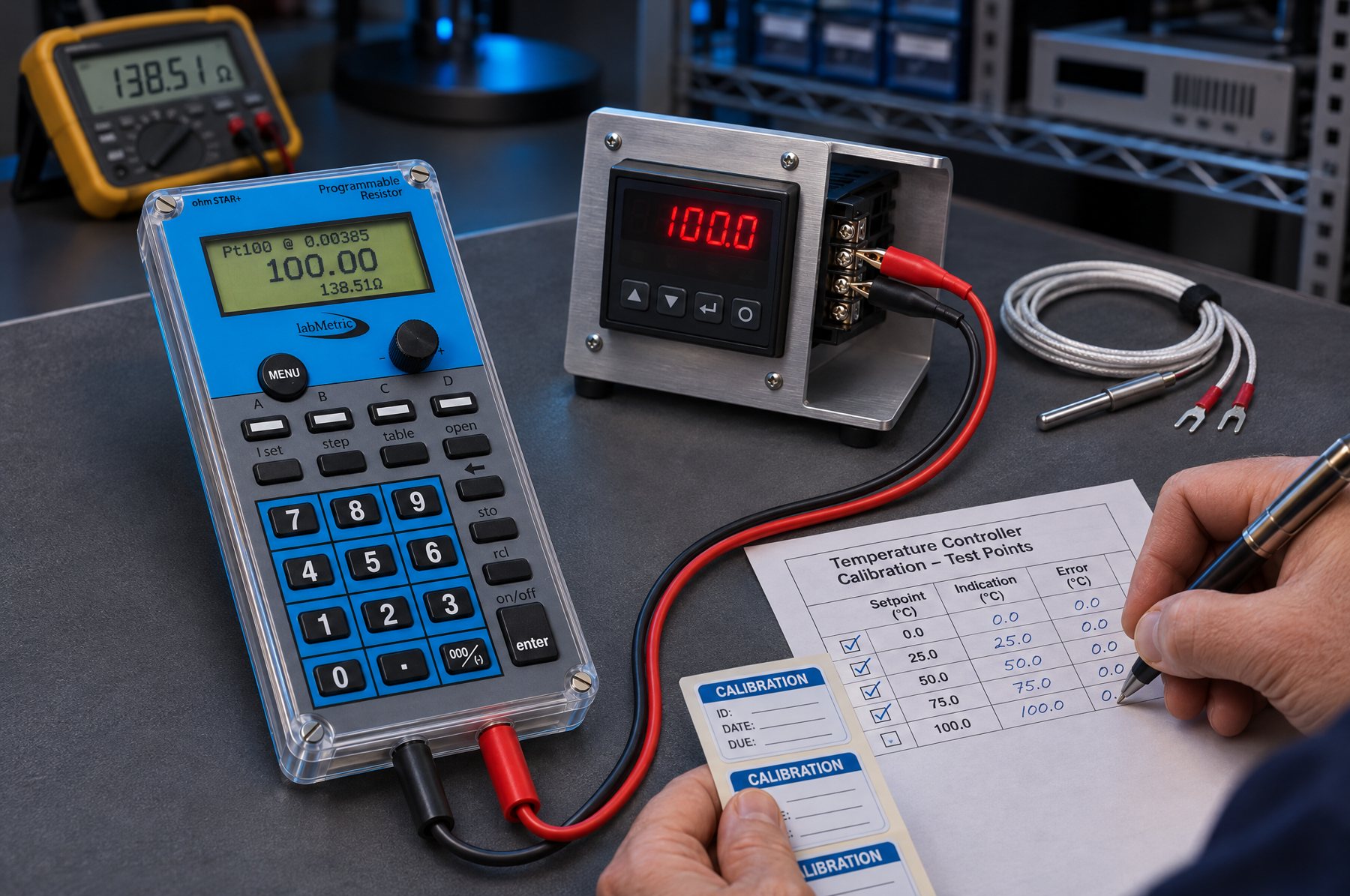
Feed a PID controller or transmitter a known Pt100 value and check what it reads. Dial a temperature and ohmSTAR outputs the exact ohms, so every test point is repeatable.
RTD calibrationohmSTAR Companion · Windows, macOS, Linux
The software, feature by feature.
One desktop app for the jobs you do every day, from a quick sweep to a calibration certificate. Six seconds a feature; click one to stay on it.
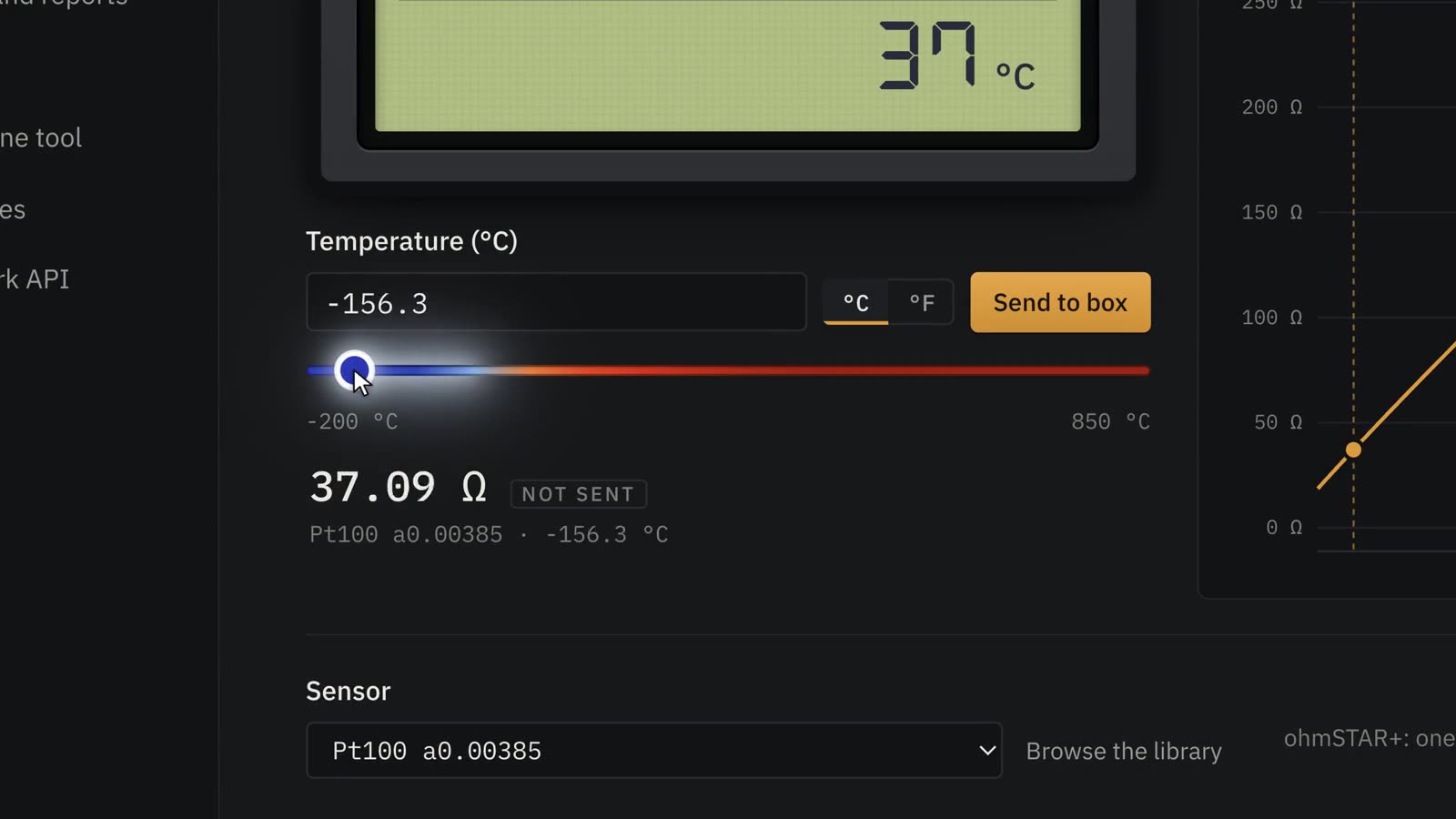
Device page
A drawn front panel with live values, and a keypad with a screen of its own.
LabMetric software is proprietary, but we're open to suggestions. Need a feature? Our in-house software team can add it.
Request a featureAI assistant · ohmSTAR Companion
AI approvedSay it.The box does it.
You don't need to know what a Steinhart–Hart coefficient is. You need to know what you want tested. The assistant does the rest: the box basically automates itself, and it asks before it touches anything.
- 01 · Ask
“Set up a 10k NTC with these Steinhart–Hart coefficients and sweep it from 0 to 100 °C in 20 degree steps.” Plain words. No menus, no tables, no maths.
- 02 · It plans, then asks
It defines the sensor, checks it against nominal (10,004.6 Ω at 25 °C), previews six values and about 12 seconds, and waits for Allow. Nothing is sent until you say so.
- 03 · The box runs it
Real relays, real ohms, the display stepping through 32,650 Ω down to 678 Ω. Then it answers the follow-up an engineer would ask: self-heating at 100 µA is under 0.01 K, not a concern.
For the person who isn't the expert
A technician, a student, a new hire: a complete, exhaustive test setup from a sentence, then it runs on its own. The expertise is in the app.
Cloud or local
Claude, OpenAI, Gemini and six more. Or a local model through Ollama, LM Studio, llama.cpp or vLLM, and nothing leaves your computer.
Guard rails
It asks before every change and can never reach calibration, keys or firmware. Every AI action is logged. Stop never asks.
Questions engineers actually ask
What is ohmSTAR?
It's a precision programmable resistor, or resistance substitution box. It replaces a decade box, outputting real resistance from 1 Ω to 25 MΩ (ohmSTAR) or 1 Ω to 5 MΩ (ohmSTAR+).
What's the difference between ohmSTAR and ohmSTAR+?
Neither is better; they cover different ranges and step sizes. ohmSTAR covers 1 Ω to 25 MΩ in 0.1 Ω steps for $987. ohmSTAR+ covers 1 Ω to 5 MΩ in 0.01 Ω steps for $1,024. Pick the one that fits your bench.
Which sensors can it simulate?
Platinum RTDs, NTC thermistors, strain gauges, conductivity cells, and potentiometric position or level sensors. Anything else works if you can write it as a table.